Friday, November 23, 2018

Transparency is back


So while I was looking at today's work, now that it's mounted on a linen base, I liked the areas of layers of transparency, much yet to do here, this is barely begun, and look what it made me do:


I remembered the silk transparencies I was working on a while back, with the idea of  working on them quilt style. I had framed and exhibited some, but here seemed to be the time to  work them up differently.

So. Wouldn't you know it, I'm working on both at once. These will be wall pieces, too fragile to be pillows.

Can't wait for my rotary blade to get here so I can act on the ideas. There will be goldwork.

Thursday, November 22, 2018

Moving along there


This is a great visual adventure, as the shapes and colors start to make sense. That ragged bit looked at first like a ragged bit, but when muffled by the organza, turned into a distant mountain range. Or possibly the Cleveland Hills, from Yorkshire childhood, which insert themselves a lot into my work without notifying me first. Meanings keep coming and going, and I started adding on top, instead of waiting to embellish. The additions are part of the composition, can't just be stuck in at the end, I now realize.

This is probably where I depart from the tradition of crazy quilting. There's more of a Gee's Bend influence moving in. I say this with humble recognition of the high art of the GB  quilt artists. I know I'm making art because my brain gets tired, and about an hour is as long as I can work without setting it aside and resting my ability to actually see what's going on.

With crafting, making something already decided on, such as knitting to a pattern, I can go on till my hands inform me they're ready to stop.

And I had to break down and shop. For rotary cutter blades. Both my cutters are down to their last blade which is blunt, so I had to. It will be nice to have cutter action that's less like gnawing and more like clean cutting.


Wednesday, November 21, 2018

New adventure in art under way

I started my foray into sort of crazy quilting, sort of applique abstract art in fabric by finding my  little stash of fabric bits. Almost all silk or linen, some embroidery, ready for a start.


I did start with the five sided center piece, the way several YouTube tutes told me to,  and after that drifted off into various other ideas. This is all hand stitching, and the seams I know I will cover are left raw, the others turned under. Quite a bit of the silk and linen I had hand dyed or stamped or both.


And there's silk from friends, (Cynthia, some from you), the center piece is Thai silk brought back by Carol P from Thailand, there are bits of organza from Girija's wedding sari, bits of my own discarded embroidery, some rescued petit point, a surprising array from someone who doesn't work with fabric..


and when I get the base done I'll use motifs from some of the crochet I have around the house, as well as motifs from my own embroidery, in need of a good home.


Sunday, November 11, 2018

Wearable wall hanging getting there

The main body is done, with many kinds of stitch patterns, beading, yarnovers, traditional and made up by the knitter as she went. Here's the whole thing, really hard to get a pic of a long piece like this with a simple camera, and details reading top to bottom.


Still to come: a length of Icord, in progress, which will be snailtrailed all over it and maybe beyond.

Then what, I wonder..

Tuesday, November 6, 2018

Curating, a rare event around here

I'm usually making, rarely looking back. But these favorite socks, Cabled Top Socks by Noreen Crome-Findlay, called for some care. Knitted ages ago with yarn given to me, which ran out, I ended up with toes in a different yarn. And wore one out. But since the worn out part was all the second yarn, it wasn't hard to pick up stitches and cut away the unwanted part.


It was triggered by seeing Arne and Carlos and their easiest sock in the world, where they knit a kind of tube up from the toe, but insert a row of scrap yarn where the heel will go. Then go back to pick up stitches on either side of the scrap yarn, to knit the heel

. Similar idea here. Picking up the stitches before removing the unwanted yarn.

The hard part was tracking down my pattern to see how to do it, and searching for a set of  size three dpns to do it. Then, nervous knitting over breakfast on election day, and here we are with the rebuild done. With another nonmatching yarn, but the other was long gone.


And, rainy cold day, these are the best socks for right now. I made and gave a couple of pairs of these socks for friends, years ago. Didn't do the cable top, but the spiral is really interesting to see as it develops. Since it molds to your foot, there's no heel turning. I made these socks a long time ago, when I was a bigger size and they were snugger then.

And the long knitting sampler idea is going on. Plus some Icord, which will decorate it once I get a lot more done. I've done several areas of beading, much to the interest of my knitting group who were unfamiliar with the process of beading using a crochet hook. I have a few of the very fine ones you need for this, and offered to give one to anyone wanting to try it out.


Let's hope we save the republic before the end of the day. If not, I will be out there working again. Actually, if so, I'll still be out there doing my bit. There's always need of some kind.

If you have the US vote and have not yet used it, please do. If you have, thank you, and maybe cast on a bit of knitting to get you through the evening of returns.

Sunday, October 28, 2018

Knitting sampler blazing on

This might be the most fun I've had in a while, wrt making stuff. I have 36 stitches, fingering weight, self striping yarn. And it's great to just try whatever stitch or pattern you fancy as you go. This might be a scarf, or a wall hanging, depends. It could be both, hanging up till I want to wear it.

As you see, it's unblocked because still on the needles, but will be much more even across the width once pressed.

Part of the interest is in seeing just how different approaches change the width, which stitches do well in a fine gauge, and there's a bit of math involved in figuring out the multiples required of a pattern. Some fit fine, others you allow stitches at the edges and set the motif in the middle.  The cable worked this way, and the Crest of the Wave, in progress at the top.

Reading top to bottom: Crest of the Wave, a variation on good old feather and fan, Shaker stitch, a garter stitch variation, which I think worked better on a bulkier yarn, like the cowls I made, then comes checkerboard, then something I invented which involved ktogs and yarnovers, was listening to an exciting mystery and never wrote it down. Then cable, haven't done that in  years, and had to get a YouTube tutorial to remember the steps.

Then Lace Ladder, which I did in miniature back in atc days, in crochet thread. It will profit from blocking, so the ladder effect will show better. Then feather and fan. Then Kelp stitch as shown in the picture I have, which had typo problems. Below is what the wording gave, pretty but not the actual stitch. I had to figure that out, and was pleased with it.

Bands of garter to separate the designs. This could go on and on! There will be beading. Snd bobbles. And maybe that great 20 line no repeat challenge,  Field of Wheat.

In this series of artist's trading cards, ATCs, you see top left, Field of Wheat, a trial motif.


And here it features in a knitted and crocheted wall hanging, Ceres, daughter of Demeter, Greek myth figures.


 Here's a bigger image, from a long ago pre digi camera shot, of Strawberry, third row middle


 and Traveling Leaf, bottom left. And you see Lace Ladder there, second row right.

And while I'm wandering down memory lane, here's a mask I knitted from one length
 of yarn, long gone into someone's collection. It's about 8x10". This was knitted designing as I went.


And here's the back of the ATC sleeve, with references in case you want to follow up. Since the name side is flipped you need to note that top left becomes top right  and so on. The address is long defunct. Barbara Walker's collection of lace patterns is worth a visit, if you can get the book. You can probably track them down on-line too, and might find them with different names, very confusing!

Wednesday, October 24, 2018

Thrills and Spills with Sticks and String

All the buttons for the second vest done, needing only attachment. And the shoulders to be seamed, I've been eyeing some nice fingering in variegated color and wondering what to make next.

Also, leafing through Big Binder of stuff I've done, remembered I had a lot of pages of Barbara Walker's book of lace patterns. Found them after an exciting search during which I found a couple of ideas for future art projects, and thought, hm.

Then in line with my usual mantra of when in doubt, do everything at once, cast on 36 stitches on size three dpns, and studied lace patterns. I decided a long scarf as a lace sampler would be just the ticket.


So I picked out a few, noticed I'd done more of them than I realized, and I'll do panels of different patterns separated by areas of garter stitch.  This is interesting as a scarf and as a walking textbook of design. And the 36 stitches are enough to accommodate the patterns, some needing garter stitches to fill in the sides. Can you see feather and fan there, and bird's-eye? And there's ladder lace to come, too. Forthcoming attractions.

Started with kelp stitch, an old one from my big binder, which means I must have made it for someone, and found quite quickly that the picture and the words didn't match up.  As you see, the openings stagger nicely, but there's a panel of garter stitch which doesn't match the pic.  I studied and realized that the pattern omitted a vital clue: it said the motif was k2 (yo k2tog) k2. The alternating, jog row, was k1(yo k2tog) k 3. As you see, as written, it will give that intervening band of garter stitch. It looks quite nice, but it's not what I was going for.

Rethinking, I figured it should have said k2 *(yok2tog) to last 2 then k2. There was a missing asterisk.


So I did another panel like that and yay, that's the answer. I really like the pattern now. There will be more lacy bits as I go, but, being from Barbara Walker's collection, there won't be any pesky typos to deal with.

So I already have a reference with the pattern as written and as corrected. It's already working as a textbook.  Amazing what two different readings can do to the result.


This is fun.

Thursday, October 18, 2018

The button up blue vest, continued, possibly finished.

The vest finished, buttons made and attached, I tried it on and decided I didn't like it. Too boxy and floppy, even when I adjusted for buttoning.

So I felted it. Boiled it briefly in suds, plunged into cold water, then another cold water, then wrung it out and gave it half an hour in a hot dryer with a towel. I had prudently buttoned it up ahead of time.


And ended with a really nice felted material. Much better texture, subtle design.  color really blazing away  I clipped the buttonholes just a bit, easy now it's felted, won't fray, for easier buttoning now the original holes are smaller.

And still not happy with the fit. So I cut up the sides and stitched a slanted seam like a dart. And now it's really nice. It fits. Very cosy, too.

I'm thinking of making a purse with the leftover yarn and felting it, now that I know how well it felts. With any luck that will be a bit simpler.

So this simple (!) vest involved knitting, felting, stitching, cursing and Dorset button making. Knitting's not for the faint of heart. At least not the way I do it!

Friday, October 12, 2018

Thing Three, the pashmina continued


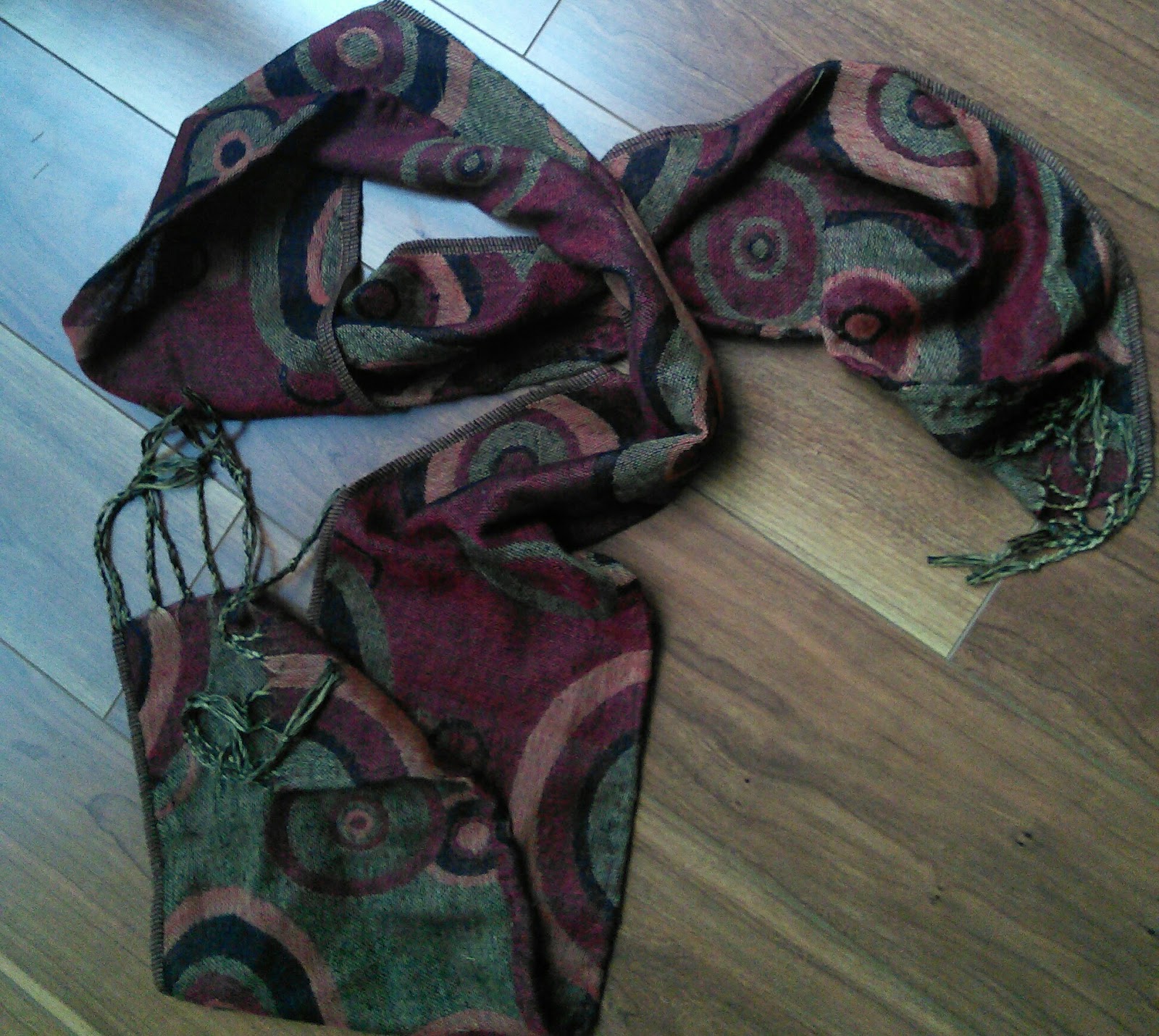
 Found a piece of black fabric, maybe liner, and made a lined purse from another bit of the pashmina.


 Inserted a pocket for phone, and after this, the whole thing folds over side to side,
 and I'll make a bead and loop closing, about where you see the bead there, using the embroidery floss seen in the second pic up there.

 I was thinking as I went and ended up with a kind of pursigami. Right for dropping into my actual purse. More fun than plan and execute!

Thursday, October 11, 2018

Cutting with abandon

After seeing the one-yard kimono jacket idea on MA's blog, and reading Sonya on Mason Dixon, I was all for trying something new. Sonya is all about making what you want to wear, fearlessly and not worrying about it, and MA's links are full of great ideas for all kinds of things you might not have thought of.


And, not being a procrastinator, rather the opposite, a hasty jumper-in,  late last night I hauled out three big scarves I was given and rarely wear, because they're too square for me. They don't drape for me.

Two are fine wool, the one in the foreground a pashmina, remember them? So they're nice in that the fabric is good.

Soooooo I cut the pashmina into a kimono jackety thing. Pinned it before hand sewing, no machine around here. And found it would be much better on someone entirely taller and more substantial than my fairly small self. Oh. I looked as if it was trying to kidnap me.

Back to the cutting board, and I now have a scarf which is the Isadora Duncan type, which I will wear once the temps and humidity drop below 80f and 6,241.


And a joke cover, not meant to be serious,  in my small gallery


And enough leftover fabric to make something else when I get an idea of what. The other two scarves are uncut for now.

Never a dull moment.

Tuesday, October 9, 2018

Dorset buttons moving right along

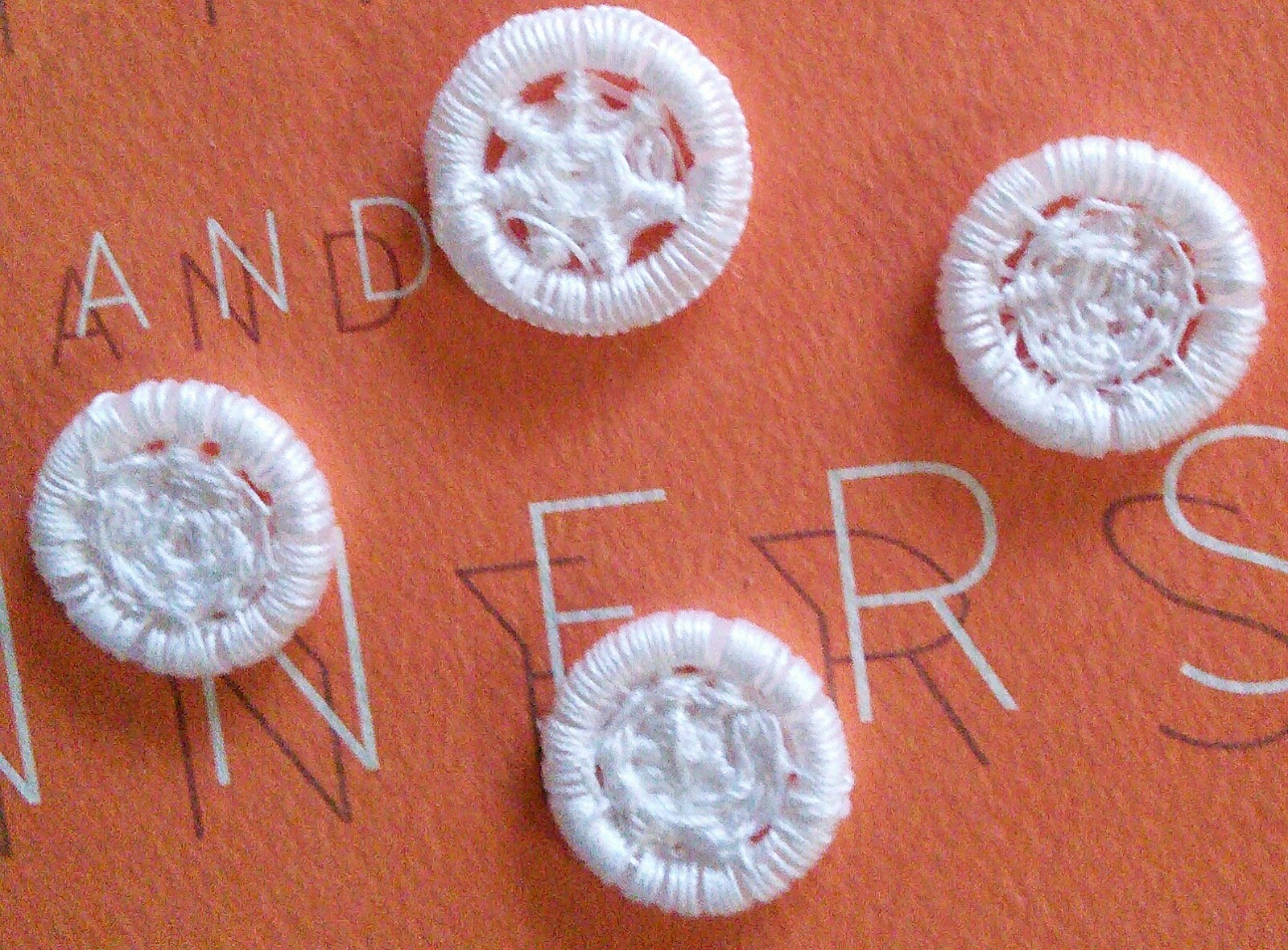
To date, the buttons for the cotton vest. Seeing them through a lens is helpful for doing subsequent ones. Also you can see tiny thread ends to snip. The idea is to vary the patterns, just to experiment with the idea. This won't be very evident once in use, but it's one of those hidden pleasures in making things.


This is really calming work, needed right now.

Sunday, October 7, 2018

New Dorset button in progress

Here's the first of the set for the cotton vest. Not finished, I just did it partially, so as to test whether it would go through the buttonholes. And as you see, it did. So I'm set to finish weaving it and its nine friends.


I'm using a size 70 thread for this, used for whitework, so it's both fine and tough enough to stand up to handling and being pushed through the buttonholes. And I had to change technique a bit.

The stitches are tight and you can't really push a needle through the knots around the inside of the ring, to establish the weaving, unlike the usual approach. Normally the knots anchor the weaving. But here I passed the thread over the ring, and held on to it until I got some weaving established. It didn't add size, because the threads slid between the stitched ones. So that seems to work.

Saturday, October 6, 2018

Buttons on, me or them.

I decided it was time for the Sewing on of the Buttons on the Blue Vest. This was after I wondered if I should first check the smoke detectors, change the oil in the car, check the mailbox, vote..well my mail in vote came today so I did vote, wielding my tiny power.

But then I had stop procrastinating, and do the buttons. I found, once done and buttoned up that I could have made the small size. I had wondered if it would be skimpy so, using her measurements, went for the medium.

Anyway I have adjusted, very simply, by buttoning it further over, and that seems to work. The fabric is open enough that I could just push buttons in without creating new buttonholes if necessary.

We'll see how the cotton one works out. I used different needles, and it's firmer. Probably the issue there will be inserting the buttons through the little holes, but I'll figure that out when the time comes. One good thing was that the Dorset buttons worked nicely, stitched on without losing any shape. I attached them with the same thread I made them with.

Anyway here's the round neck side

 And the v neck side, the other side is sticking up behind it


And a gallant attempt at a selfie!  Poor lighting uncooperative model..but you can just about get the gist.

Tuesday, September 25, 2018

Dorset buttons in production

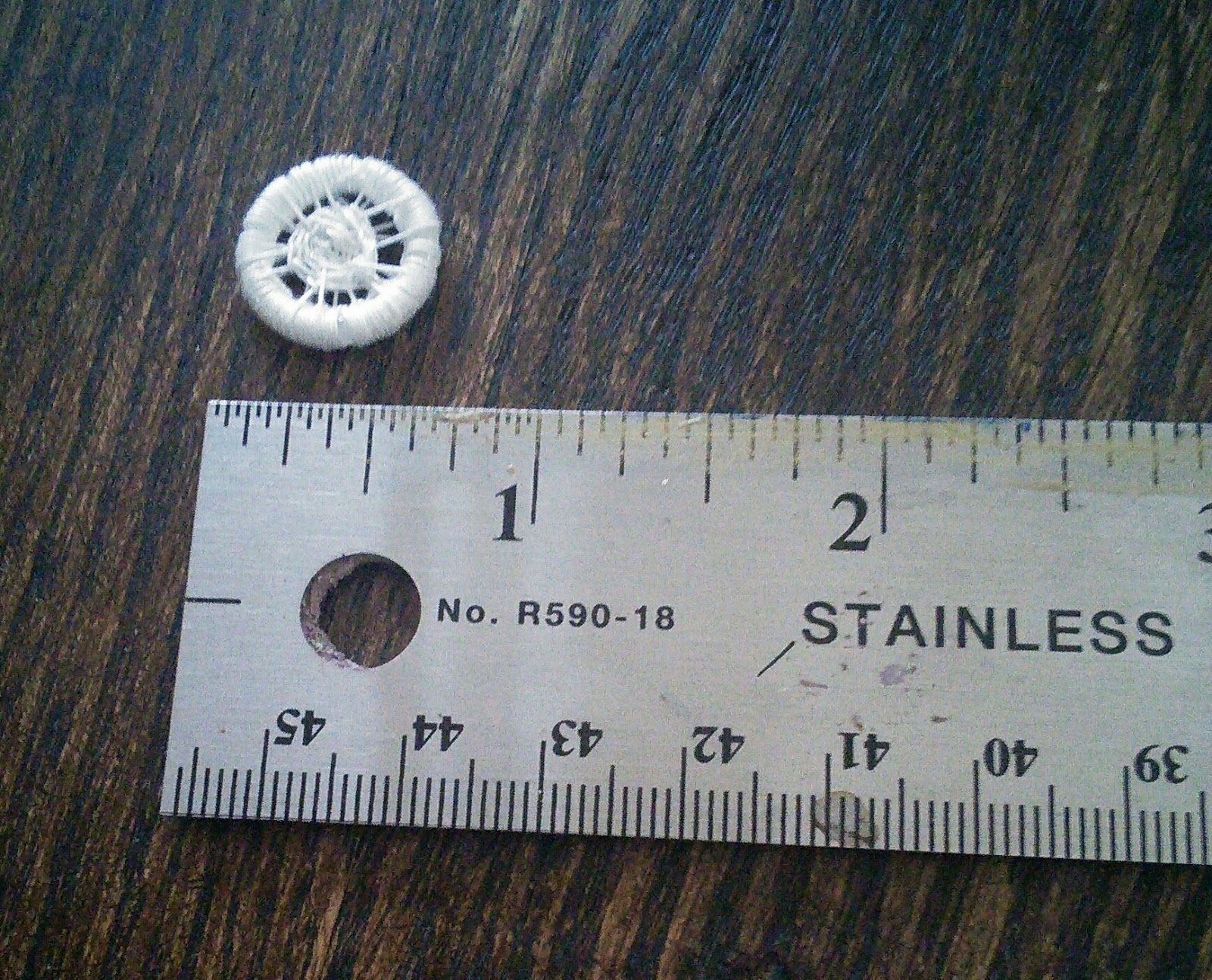
This afternoon being one of torrential rain, it was a good day to make the Dorset buttons needed for the blue vest. So, before my hand started to cramp up, I got a few done. They're small, as you see, so I couldn't do any fancy footwork with the designs, just stuck to needleweaving wherever it fitted. I'd already tested that they would actually fit through the buttonholes.


When I do the other vest, I'll use a finer cotton thread and have a bit of a good time with more designs. The thread I've picked out is used for whitework embroidery, so it can stand some use, as buttons will need to.

Vest complete, Dorset buttons next

The cozy vest is now done, and my inner stitcher comes into play, because I now need ten Dorset buttons. Both front and back of the vest are buttoned. Shown here not yet blocked and pressed, but the iron is two floors up, and the makings of the buttons right to hand.


That's what all the little threads are about, marking both buttonholes and buttons. The holes vanish into the fabric as soon as you make them, so it seemed advisable to mark them. Keeps the volume of cursing down to a dull roar.

The ball of yarn is crochet cotton, which I dyed with blue, variegating as I went. It's proved useful, what with knitting budgies and tiny doll clothes, and now it will be good for the buttons, able to stand up to buttoning and unb. Without fraying. At least, usual disclaimer, that's the plan.

Photographer's note: the vest is a sapphire blue, not with the purply cast shown, and the crochet thread is sapphire to white mix. The rings for the buttons, since I don't have any sheep horn handy, are from a fellow stitcher's grandmother.


The pattern designer airily says hardly any finishing, just the shoulders. Which is true if you don't count stitching ten buttons, and in my case, making them first, as finishing. I did enjoy the design though, just a minor quibble. Pattern is from Sally Melville's The Knit Stitch.

I'm halfway through another, in cotton thread, for a different season. As you see, the stitch definition is pretty good in both the wool and the cotton.


Whether it gets Dorset buttons depends on how the current ones work. Oh, and credit where it's due, the idea of the buttons came from Mary Anne of Magpie's Mumblings. This is all your doing, MA!

Monday, September 17, 2018

Dyeing and felting made a dubious item into a lovely one

The dyeing ended yesterday morning after 12 hours cooling in the vat. Rinsed it thoroughly, dried and noted the improvement.


I used red onion dye I made last year and froze. A reddish color. The idea was to knock down the harsh green (opposite on the color wheel, color theory comes into play) and blunt the effect of the acid yellow and bitter mustard, both of which brought up a taste in my mouth. And they worked nicely. Partly it was the gentle dye change, partly the felting, just a bit, which created a nice fabric.


So we're set with this one. The second picture is a truer color.

 It's the same pattern as the one I knitted a few weeks ago.
A bit hot for modeling wool felt, but I expect days will come when I'll be glad to wrap up in it.

Saturday, September 15, 2018

New natural dyeing caper

Inherited a nicely knitted long tail shawly thing in colors I don't like at all, I'm trying a bit of dyeing.


Here's the dye bath with red onionskin dye, from the freezer, thawing gently, with mordant of alum and cream of tartar, and the shawl resting on it. I'd soaked it in water for a couple of hours, then moved to lukewarm water before squeezing it out and adding to the thawing dye. Gradual temperature change to avoid felting. It might be superwash, no way to know, but best to be cautious.

I'm baking bread in the oven, but all the dye ingredients and mordant are food safe, so no worries other than finding room for everything.

So I'm interested in seeing what shade I get from this experiment.

Monday, September 10, 2018

Socks done and ready for their new owner

Finished and pressed the socks today, very pleased they're done and the yarn juuust lasted long enough. I liked the idea of literally knitting them together alternately, so they matched, and both got finished. I'm going to do that again. I didn't Kitchener the toes, but sort of invented my own version which seems to work fine, looks neat enough. I really prefer toe up, but this was embarked on so I followed the pattern of top down.


Now I can return to my vests. They're much bigger yarn and needles, after the fineness of the sock yarn and size 2 needles. They'll feel Brobdingnagian by comparison.


Saturday, September 8, 2018

Knitting group creative byways

Yesterday's meeting included the reveal of his first zine by Randy. He's a self taught crocheter,


gardener, working on cooking, going to college and doing delivery driving, creative guy. And here he us with his hilarious zine, and funny and sweet story of hat wars. We want him to write more exploits of his main characters, and maybe he will.

We passed it round the group


and gave it several stars.


Saturday, September 1, 2018

Collaborative art! knitting style

This is how women's art works. We learn from women long gone, and once in a while we get to collaborate with a departed sister-in-knitting.


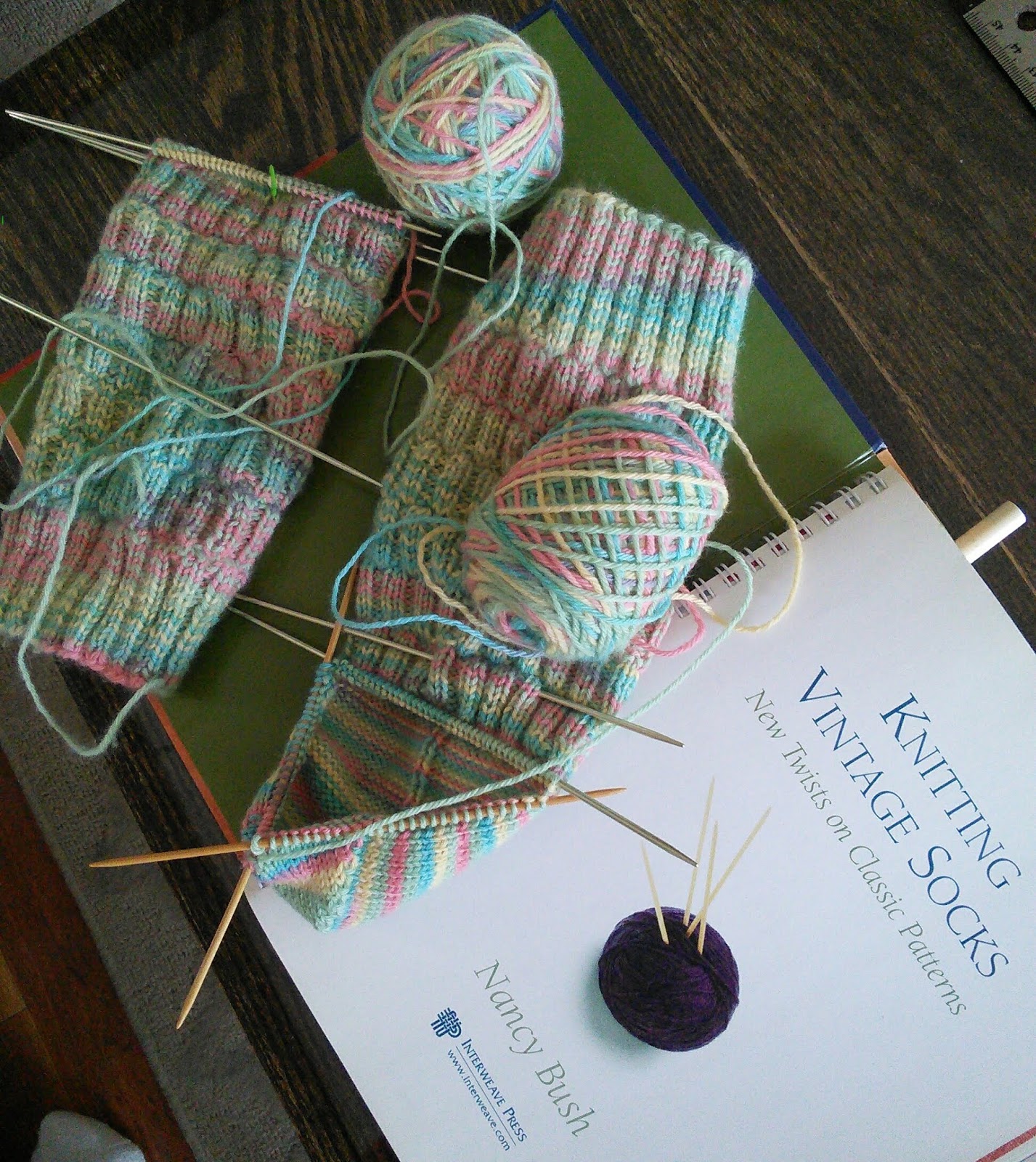
I've finished the first heel turn, and to say I'm pleased with it is putting it mildly. I think Jeanette's lending a hand. Now I'm on to the second, following her plan on doing both of them simultaneously. That way they match and get done together. See that cool seam effect up the back of the heel? And the lovely triangle as the shortrowing starts to work. Easy stitch pick up is guaranteed by the slipped stitches at row beginnings on the flap. Best work I've done to date, thanks to this design. It's worked on four needles,which I much prefer over five. I just like working around a triangle rather than a square.

Once finished they're promised to my friend, js sister.  And I've messaged the author via Ravelry to thank her, too. Wonderful instructions, clear and friendly. And another way women preserve their art, by retrieving and updating long ago patterns to share on. We have Nancy Bush to thank for reviving these nineteenth century treasures.